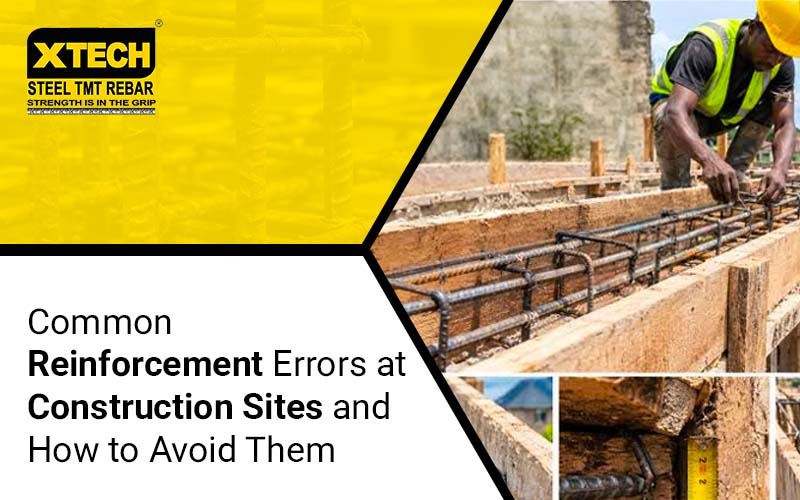
Common Reinforcement Errors at Construction Sites and How to Avoid Them
The strength and durability of a reinforced concrete structure depend on more than just the quality of concrete and steel. How reinforcement bars are measured, cut, bent, placed and secured also plays a crucial role in the overall performance of a building.
Even when good-quality TMT bars are used, mistakes during reinforcement work can affect the structural design, reduce durability and lead to costly repairs. Incorrect bar spacing, inadequate concrete cover, improper lap lengths and poor placement are some of the common issues encountered at construction sites.
Understanding these errors and taking preventive measures can help builders, contractors and site engineers maintain better construction quality.
In this blog, we look at some common reinforcement errors and practical ways to avoid them.
1. Incorrect Bar Spacing
Reinforcement bars must be placed at the spacing specified in the structural drawings. When bars are placed too close together or too far apart, the reinforcement may not perform as intended.
Incorrect spacing can also make it difficult for concrete to flow and compact properly around the bars, increasing the risk of voids and honeycombing.
How to avoid it:
● Follow the approved structural drawings and Bar Bending Schedule (BBS).
● Measure and mark the required spacing before placing reinforcement.
● Secure the bars properly using binding wire.
● Check the spacing before concrete is poured.
2. Insufficient or Incorrect Concrete Cover
Concrete cover is the distance between the outer surface of the reinforcement and the surface of the concrete. It protects the steel from moisture, environmental exposure and fire while helping maintain the required durability of the structure.
If the cover is insufficient, reinforcement may become more vulnerable to corrosion. Excessive cover, on the other hand, can affect the effective depth of the structural member.
How to avoid it:
● Use suitable cover blocks and spacers to maintain the specified cover.
● Follow the cover requirements in the structural drawings and applicable standards.
● Provide adequate support to reinforcement so that it does not shift during concreting.
● Check the cover at different locations before pouring concrete.
The required cover varies depending on the structural member, exposure conditions and design requirements. It should never be determined by guesswork.
3. Incorrect Lap Length and Placement
When reinforcement bars are not long enough to cover the required length, they are joined through overlapping sections known as lap splices. These overlaps help transfer forces between the connected bars.
Using an incorrect lap length or placing laps in unsuitable locations can affect the transfer of stress and compromise structural performance. Placing too many laps at the same section can also create reinforcement congestion.
How to avoid it:
● Follow the lap length and splice locations specified by the structural engineer.
● Refer to the approved drawings and BBS before joining bars.
● Stagger lap locations wherever required by the design.
● Avoid placing multiple laps in the same section unless specifically permitted.
● Ensure proper concrete compaction around lap zones.
Lap length is not a fixed value for every project. It depends on factors such as bar diameter, concrete grade, steel grade, stress conditions and design requirements.
4. Improper Cutting and Bending of TMT Bars
Reinforcement bars are often cut and bent into different shapes to suit the requirements of beams, columns, slabs and foundations. Incorrect bending angles, inaccurate cutting lengths and unsuitable bending practices can affect the intended reinforcement arrangement.
Repeated or improper bending and straightening can also damage bars and should not be carried out without approval.
How to avoid it:
● Use the approved BBS for cutting and bending instructions.
● Measure bars carefully before cutting.
● Use suitable tools and equipment for bending.
● Follow the specified bend shapes and dimensions.
● Do not heat, rebend or modify reinforcement bars without approval from the responsible engineer.
Accurate cutting and bending help ensure that reinforcement fits correctly within the structural member.
5. Incorrect Placement of Reinforcement
Using the correct number and size of bars is not enough. They must also be positioned correctly according to the structural design.
For example, placing top reinforcement in a slab or beam at the wrong level can affect its effective depth and ability to resist the intended forces. Similarly, incorrect placement of column bars or stirrups can affect the reinforcement arrangement.
How to avoid it:
● Refer to the latest approved structural drawings.
● Check the position and orientation of every reinforcement layer.
● Use chairs, spacers and supports to maintain the required levels.
● Tie reinforcement securely to prevent movement during concrete placement.
● Conduct a final inspection before concreting.
6. Inadequate or Incorrect Use of Stirrups and Ties
Stirrups and ties are important components of beam and column reinforcement. They help hold the main reinforcement in position and provide the required shear reinforcement or confinement, depending on the structural member.
Incorrect spacing, missing stirrups, improper hook details or insufficient lateral support can affect the performance of the structure.
How to avoid it:
● Follow the specified stirrup and tie diameter, spacing and configuration.
● Check the reinforcement details at beam-column joints.
● Ensure hooks and bends follow the approved detailing requirements.
● Verify the arrangement before concrete is poured.
Never adjust stirrup spacing or omit reinforcement to make fabrication or installation easier.
7. Poor Handling and Storage of Reinforcement Bars
TMT bars are often stored at construction sites for extended periods before being used. Improper storage and rough handling can affect their condition and make reinforcement work more difficult.
Bars placed directly on wet ground or exposed to unsuitable storage conditions may accumulate mud, oil, loose rust and other contaminants. Rough handling can also cause unwanted bending or deformation.
How to avoid it:
● Store reinforcement bars on raised supports rather than directly on the ground.
● Organise bars according to their diameter and grade.
● Keep them away from oil, grease, mud and other contaminants.
● Protect stored steel from prolonged exposure to unsuitable site conditions.
● Inspect bars before use and remove loose contaminants where necessary.
Surface condition should be assessed before installation. Loose rust, scale, mud, oil and other substances that can affect the bond between steel and concrete must be addressed.
8. Reinforcement Congestion
Reinforcement congestion occurs when too many bars, closely spaced reinforcement layers or overlapping connections occupy a limited space within a structural member.
This can make it difficult for concrete to pass through the reinforcement and for vibrators to reach all areas during compaction. As a result, voids and honeycombing may develop.
How to avoid it:
● Review reinforcement details before fabrication and installation.
● Follow the specified bar spacing and arrangement.
● Coordinate reinforcement placement with concrete pouring and compaction requirements.
● Ensure adequate space for concrete flow and vibrator access.
● Consult the structural engineer if reinforcement congestion is identified.
Do not remove, shift or reduce reinforcement to solve congestion without an approved design revision.
9. Not Securing Reinforcement Before Concreting
Reinforcement bars can move during concrete pouring if they are not properly tied and supported. This may affect their spacing, alignment and concrete cover.
Top reinforcement in slabs is particularly vulnerable to displacement when workers or equipment move across the reinforcement cage.
How to avoid it:
● Secure reinforcement at appropriate intersections using binding wire.
● Provide adequate chairs and supports for top reinforcement.
● Check the stability of the reinforcement cage before pouring.
● Avoid unnecessary movement across unsupported reinforcement.
● Monitor reinforcement positioning during concrete placement.
10. Skipping Pre-Pour Reinforcement Inspection
One of the most important steps in reinforcement work is the inspection carried out before concrete is poured. Once the reinforcement is covered with concrete, identifying and correcting placement errors becomes much more difficult.
Skipping this inspection can allow incorrect bar sizes, missing reinforcement, inadequate cover or misplaced laps to go unnoticed.
How
to avoid it:
Before
concreting, site engineers should verify:
● Bar diameter, grade and quantity against the approved drawings.
● Reinforcement spacing and placement.
● Lap lengths, anchorage and hook details.
● Concrete cover and the positioning of cover blocks.
● Stirrups, ties and supporting arrangements.
● Cleanliness of reinforcement.
● Stability of the reinforcement cage.
Any discrepancies should be corrected and approved by the responsible engineer before concrete placement begins.
Why Quality TMT Bars Matter in Reinforcement Work
Correct reinforcement practices and quality steel go hand in hand. While proper installation ensures that reinforcement follows the structural design, the quality of TMT bars contributes to the strength, ductility and bonding performance required in reinforced concrete construction.
At XTech TMT, we manufacture TMT reinforcement bars in Fe 500 and Fe 500D grades, with sizes ranging from 6 mm to 32 mm. Manufactured using German Thermex quenching technology, our products undergo quality checks to support the requirements of modern construction.
Choosing the appropriate grade and diameter, as specified by the structural design, is an important step towards building dependable structures.
Strength Lies in the Details
Reinforcement errors may seem minor during construction, but their impact can extend to the strength, durability and long-term performance of a building.
From maintaining the correct concrete cover to ensuring proper lap lengths, bar spacing and reinforcement placement, every step requires attention to detail. Following approved structural drawings, using a properly prepared BBS and conducting inspections before concreting can help prevent avoidable mistakes.
At XTech TMT, we believe that quality construction begins with the right materials and the right practices. Because building stronger structures requires attention at every stage.
XTech TMT — Engineered for Strength. Built for Trust.
For product enquiries, get in touch with us:
Phone: 91 70990 77676
Email: info@kdindia.com
Website:https://www.xtechtmt.com/