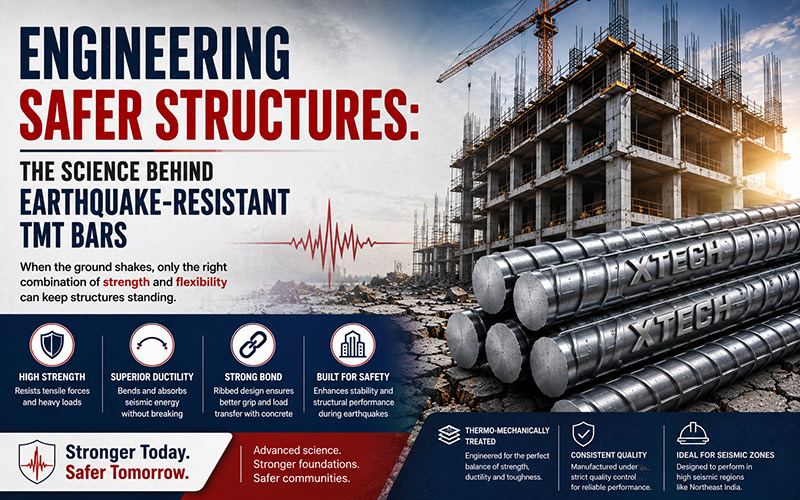
Engineering Safer Structures: The Science Behind Earthquake-Resistant TMT Bars
Earthquakes are among nature's most powerful and unpredictable forces. While engineers cannot prevent seismic events, they can design structures capable of withstanding their impact and protecting lives. In regions like Northeast India, where seismic activity is a constant reality, structural safety is not merely a design preference - it is a necessity.
Engineers, architects, and builders must account for the forces that earthquakes exert on structures and ensure that buildings are designed to withstand them. One of the most critical components of earthquake-resistant construction is the quality of the TMT bars used for reinforcement.
But what makes a TMT bar capable of handling seismic forces? The answer lies in science, engineering, and advanced manufacturing technology.
Understanding How Earthquakes Affect Buildings
During an earthquake, the ground moves rapidly in multiple directions, generating forces that travel through a structure and place immense stress on beams, columns, slabs, and foundations.
To withstand these forces, a building must be able to:
- Dissipate and withstand seismic energy
- Distribute stress effectively
- Flex without collapsing
- Maintain structural stability during ground movement
Structures that are excessively rigid may crack or fail under stress. In contrast, structures that combine strength with flexibility are better equipped to withstand seismic forces.
This is where high-quality TMT bars play a vital role.
Why Reinforcement Steel Matters
Concrete is exceptionally strong under compression but relatively weak when subjected to tension.
Steel reinforcement compensates for this limitation by providing tensile strength, enabling the structure to handle dynamic loads and stresses generated during seismic activity.
During an earthquake, reinforcement steel helps:
- Resist tensile forces
- Reduce structural deformation
- Prevent sudden structural failure
- Improve overall stability
The quality and performance of reinforcement steel can significantly influence how a building behaves during seismic events.
The Importance of Ductility
One of the most important characteristics of earthquake-resistant TMT bars is ductility.
Ductility refers to a material's ability to bend, stretch, or deform under stress without breaking. During an earthquake, the reinforcement must be capable of undergoing controlled deformation while continuing to support the structure.
Highly ductile TMT bars provide:
- Better shock absorption
- Greater flexibility
- Improved structural resilience
- Enhanced safety during earthquakes
In seismic zones, ductility is often just as important as strength because it allows a structure to absorb and dissipate energy without experiencing sudden failure.
Strength Alone Is Not Enough
Many people assume that stronger steel automatically translates into safer structures.
However, earthquake-resistant construction requires a careful balance between:
- High tensile strength
- Ductility
- Toughness
- Energy absorption capacity
A TMT bar that is extremely strong but lacks flexibility may not perform effectively during seismic activity.
Modern TMT bars are engineered to achieve this balance, enabling structures to withstand both static loads and dynamic seismic forces.
The Science Behind Thermo-Mechanical Treatment
The superior performance of modern TMT bars is largely the result of the thermo-mechanical treatment (TMT) process.
This advanced manufacturing technique creates a unique internal structure that combines strength and ductility within a single bar.
The process involves:
Rapid Surface Cooling
Immediately after hot rolling, the outer layer of the steel is rapidly cooled using controlled water jets. This creates a hardened outer surface with high strength.
Self-Tempering
The heat retained within the core gradually tempers the outer layer, improving toughness and durability.
Controlled Cooling
The bars are then allowed to cool naturally, resulting in a softer and more ductile inner core.
The result is a TMT bar with:
- A strong outer layer
- A tough transition zone
- A flexible and ductile core
This combination provides the ideal balance of strength, toughness, and flexibility required for earthquake-resistant construction.
Strong Bonding with Concrete
Earthquake-resistant performance depends not only on the steel itself but also on how effectively it interacts with concrete.
The ribbed surface of TMT bars enhances bonding strength by creating a firm mechanical grip within the concrete matrix.
This helps:
- Improve load transfer
- Reduce slippage
- Enhance structural stability
- Strengthen performance during seismic events
A stronger bond ensures that steel and concrete function together as a unified structural system.
Why Consistency Matters
Even the most sophisticated structural design can be compromised if reinforcement quality is inconsistent.
This is why stringent quality control is critical in TMT bar manufacturing.
Engineers look for:
- Uniform strength
- Consistent dimensions
- Reliable performance
- Compliance with established quality standards
Consistency ensures that every section of a structure performs as intended when subjected to seismic stresses.
Why Earthquake Resistance Matters in Northeast India
Much of Northeast India falls within Seismic Zones IV and V, the highest earthquake-risk classifications under India's seismic zoning map.
Frequent tremors, complex geological conditions, and a history of significant earthquakes make earthquake-resistant construction especially important across the region.
Builders, developers, and homeowners must prioritize:
- Proper structural design
- Quality construction practices
- Reliable reinforcement steel
Using high-quality TMT bars is one of the most effective ways to improve structural resilience and long-term safety.
The XTech Approach to Structural Safety
At XTech TMT, every bar is engineered with performance, reliability, and durability in mind.
Through advanced manufacturing processes and stringent quality control measures, XTech TMT is designed to provide the strength, ductility, and consistency required for structures designed to withstand seismic stresses.
By combining high tensile strength, superior flexibility, and dependable quality, XTech TMT supports the construction of safer and more resilient structures, particularly in regions where seismic considerations are critical.
Building for Resilience
Earthquake-resistant construction is not about making buildings indestructible; it is about enabling them to perform safely under extreme conditions.
The science behind modern TMT bars demonstrates how advanced metallurgy, engineering, and manufacturing precision work together to improve structural resilience.
By combining strength, ductility, and durability, high-quality TMT bars help structures withstand seismic stresses and reduce the risk of catastrophic failure. For homeowners, builders, and engineers alike, choosing the right reinforcement is not merely a construction decision—it is an investment in safety, longevity, and peace of mind.
Because when the ground shakes, a building's true strength lies in the quality of the materials hidden within its concrete framework.
Connect With Us
🌐 Website: www.xtechtmt.com
📞 70990 77676
📧 info@kdindia.com
XTech TMT — Engineered for Strength. Built for Resilience.