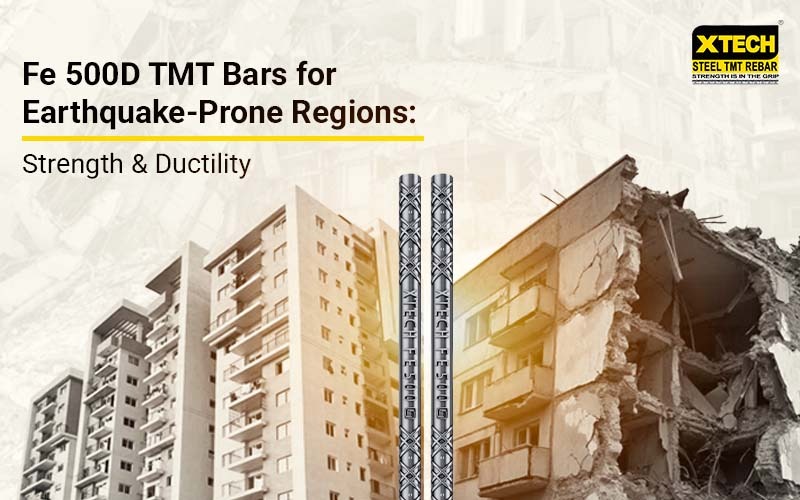
Fe 500D TMT Bars for Earthquake-Prone Regions: Strength & Ductility
In earthquake-prone regions, reinforcement steel needs to provide more than strength. It also needs sufficient ductility to accommodate deformation under demanding structural conditions.
Fe 500D TMT bars are designed to combine a minimum yield strength of 500 MPa with higher ductility requirements than standard Fe 500 grade. These properties can make Fe 500D a suitable reinforcement option for structures designed for seismic conditions, subject to the structural engineer's design and applicable building codes.
Under IS 1786, Fe 500D is a specified grade of high-strength deformed steel reinforcement with requirements covering yield strength, tensile strength, elongation, chemical composition and other properties.
What Is Fe 500D TMT Steel?
Fe 500D is a grade of thermo-mechanically treated (TMT) reinforcement steel commonly used in reinforced concrete construction.
The “500” refers to the minimum yield strength of 500 MPa. The “D” indicates the higher ductility requirements associated with the grade.
According to the BIS specifications for IS 1786, Fe 500D has a minimum yield strength of 500 N/mm², a minimum tensile strength of 565 N/mm² and a minimum elongation of 16 percent under the referenced specification.
This combination of strength and ductility is particularly relevant when reinforcement needs to withstand significant deformation without sudden failure.
Why Is Fe 500D Considered for Seismic Construction?
Earthquake forces can subject a structure to repeated and rapidly changing loads. Reinforcement therefore needs to perform under conditions where strength alone may not be sufficient.
Ductility allows steel reinforcement to undergo deformation while continuing to carry load. This characteristic is important in structural systems designed to dissipate energy during seismic events.
Fe 500D's higher ductility requirements can therefore be advantageous in applications where seismic performance and structural detailing call for ductile reinforcement.
However, the choice of reinforcement grade should always be based on the structural design, applicable codes and the recommendations of the project's qualified structural engineer.
Why Does Ductility Matter During an Earthquake?
During an earthquake, buildings may experience lateral movement, vibration and deformation.
A highly ductile reinforcement system can deform considerably before failure, allowing the structure to undergo controlled deformation rather than experiencing sudden brittle failure.
This is one reason ductility is an important consideration in seismic-resistant structural design.
Fe 500D provides a combination of high yield strength and higher ductility requirements, making it relevant for construction where these characteristics are required.
Fe 500 vs Fe 500D: What's the Difference?
Both Fe 500 and Fe 500D have a minimum yield strength of 500 MPa. The important distinction is their ductility requirements.
Property: Minimum yield strength
Fe 500:
500 MPa
Fe 500D:
500 MPa
Property: Ductility requirements
Fe 500:
Standard
Fe 500D:
Higher
Property: Tensile performance
Fe 500:
Specified under IS 1786
Fe 500D:
Specified under IS 1786
Property: Seismic relevance
Fe 500:
Depends on structural design and applicable codes
Fe 500D:
Higher ductility can be advantageous where required.
The exact grade and reinforcement specification should be selected according to the structural design and applicable standards. BIS testing requirements for IS 1786 include yield stress, tensile strength, elongation, bend and rebend tests, among other properties.
Strength and Flexibility: Finding the Right Balance
For modern construction, reinforcement steel needs to balance strength with ductility.
Very high strength without adequate ductility can limit a material's ability to accommodate deformation. Conversely, reinforcement must also have sufficient strength to carry the loads specified in the structural design.
Fe 500D is designed to provide this balance by combining a 500 MPa minimum yield strength with higher ductility requirements.
This makes the grade relevant to a wide range of reinforced concrete applications, including structures designed for seismic conditions.
How TMT Manufacturing Affects Performance
The manufacturing process plays an important role in the properties of TMT reinforcement.
Thermo-mechanical treatment involves controlled processing and rapid cooling of the hot-rolled steel to develop the desired combination of strength and ductility.
XTech TMT uses German Thermex quenching technology in its manufacturing process. The company states that its manufacturing setup is designed to produce TMT bars with a balance of strength, ductility and structural consistency.
XTech also states that its bars are produced through direct rolling from molten steel billets and undergo in-house testing.
Why Steel-Concrete Bonding Matters
Reinforcement steel does not work independently. Its performance within an RCC structure also depends on how effectively it bonds with concrete.
The ribbed surface of TMT bars helps create mechanical interlocking between the reinforcement and surrounding concrete.
XTech TMT uses a Double X-Rib design, which the company states is intended to enhance grip and bonding with concrete.
Good bonding helps reinforcement transfer stresses effectively between steel and concrete as part of the structural system.
Why Fe 500D Matters for Northeast India
Northeast India presents a combination of challenging construction conditions, including seismic considerations, mountainous terrain, heavy rainfall and, in several areas, high humidity.
States such as Assam, Arunachal Pradesh, Meghalaya, Manipur, Mizoram, Nagaland, Tripura and Sikkim have diverse construction environments where material selection needs to account for local conditions as well as structural requirements.
For projects in earthquake-prone areas, reinforcement with appropriate strength and ductility is an important consideration.
XTech TMT manufactures Fe 500 and Fe 500D TMT bars in diameters ranging from 6 mm to 32 mm and supplies products across Northeast India.
XTech Fe 500D TMT Bars
XTech TMT offers Fe 500 and Fe 500D TMT bars from 6 mm to 32 mm for residential, commercial and infrastructure applications. The company states that its manufacturing process incorporates German Thermex quenching technology, Double X-Rib design and in-house quality testing.
The company's focus on manufacturing and distribution in Northeast India also allows it to serve projects across Assam and neighbouring states.
For construction projects, however, the appropriate reinforcement grade and diameter should always be determined by the structural design and project requirements.
Fe 500D Does Not Make a Building Earthquake-Proof
It is important to understand that no TMT bar by itself can make a building earthquake-proof.
The seismic performance of a building depends on several factors, including:
- Structural design
- Foundation design
- Reinforcement detailing
- Concrete quality
- Construction practices
- Material quality
- Applicable building codes
- Site and soil conditions
Fe 500D can contribute to a structural system where its strength and ductility characteristics are appropriate, but it is only one component of an earthquake-resistant design.
How to Choose TMT Bars for Seismic Construction
When selecting reinforcement steel for a construction project, consider:
1. Grade
Check whether the specified grade matches the structural design.
2. Applicable standards
Ensure that the reinforcement meets the relevant BIS requirements, including IS
1786 where applicable.
3. Ductility
For seismic applications, discuss the required ductility characteristics with
the structural engineer.
4. Testing and quality control
Look for appropriate testing and documentation for the reinforcement supplied
to the project.
5. Manufacturing process
Understand the manufacturing technology and quality-control systems used by the
manufacturer.
6. Availability
A reliable regional supply chain can help maintain consistent material
availability throughout a construction project.
Frequently Asked Questions
Is Fe 500D TMT steel suitable for earthquake-prone areas?
Fe 500D can be suitable for structures designed for seismic conditions because it combines a 500 MPa minimum yield strength with higher ductility requirements. The final reinforcement specification should be determined by the structural engineer and applicable codes.
What does Fe 500D mean?
“Fe” refers to iron/steel reinforcement, “500” refers to the minimum yield strength of 500 MPa, and “D” indicates the higher ductility requirements associated with the grade.
What is the difference between Fe 500 and Fe 500D?
Both grades have a minimum yield strength of 500 MPa. Fe 500D has higher ductility requirements, including a higher minimum elongation requirement under the referenced IS 1786 specification.
Is Fe 500D earthquake-proof?
No. Fe 500D is a reinforcement steel grade; it does not make a structure earthquake-proof. The earthquake performance of a building depends on its complete structural design, detailing, materials and construction.
What size Fe 500D TMT bar should I use?
The required bar
diameter depends on the structural design, member type, loading conditions and
reinforcement detailing. The size should be specified by the structural
engineer rather than selected solely on the basis of the building location.
Building for the Future Starts with the
Right Reinforcement
In earthquake-prone regions, reinforcement steel needs to provide an appropriate combination of strength and ductility.
Fe 500D TMT bars, with their 500 MPa minimum yield strength and higher ductility requirements, can be an appropriate reinforcement option for structures where these characteristics are specified by the structural design.
For construction in Northeast India, factors such as seismic conditions, climate, terrain, concrete bonding, manufacturing quality and material availability also need to be considered.
XTech TMT manufactures Fe 500 and Fe 500D TMT bars from 6 mm to 32 mm and states that its products are manufactured using German Thermex quenching technology and undergo in-house testing.
Ultimately, choosing the right TMT bar is only one part of building a safe and durable structure. Proper engineering, detailing, construction quality and compliance with applicable standards remain equally important.
practices, can help create structures designed to perform under demanding conditions.
XTech TMT - Engineered for Strength. Built for Trust.
For product information and assistance, connect with XTech TMT.
Connect With Us
🌐 https://www.xtechtmt.com
📞 91 70990 77676
📧 info@kdindia.com