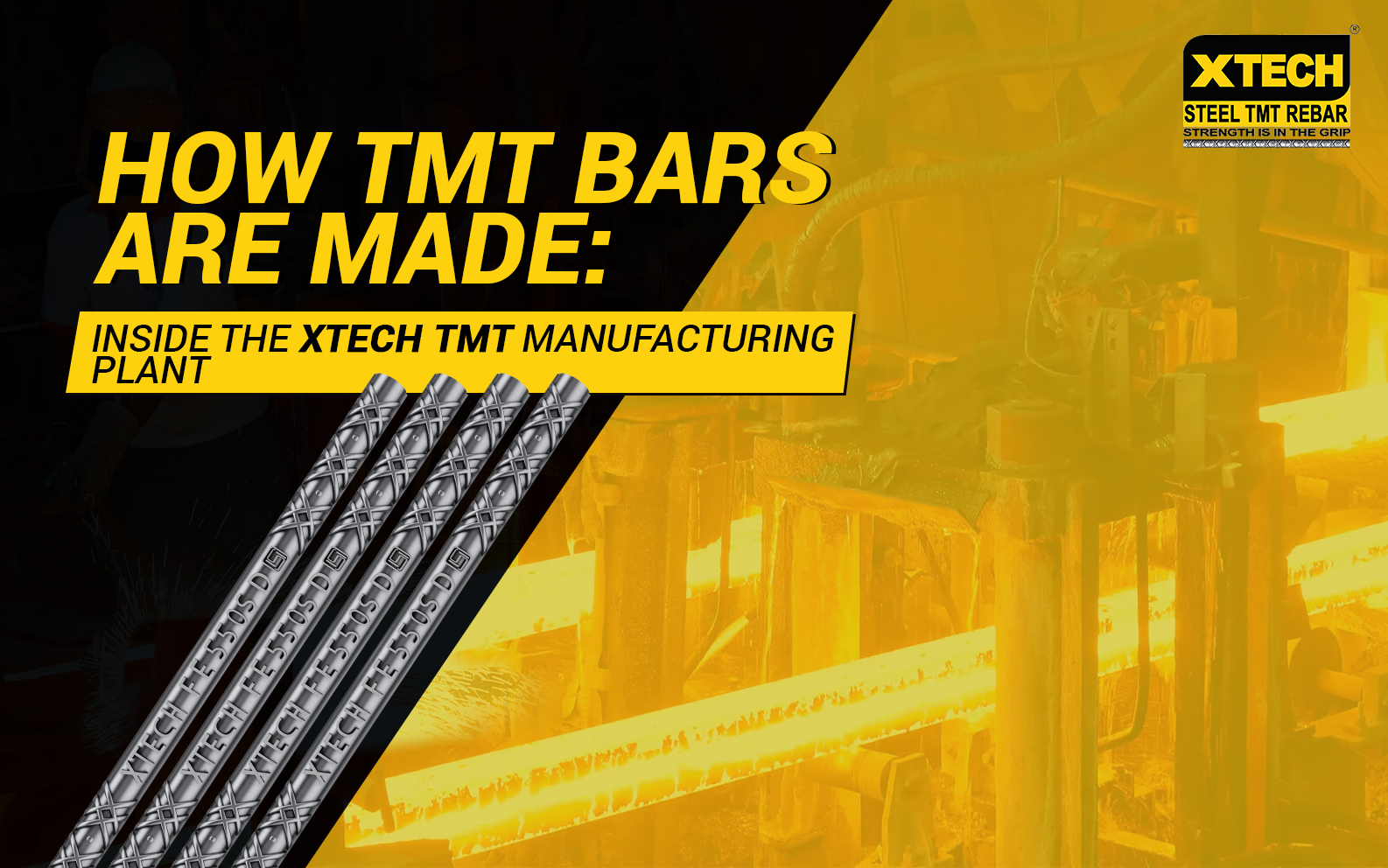
How TMT Bars Are Made: Inside the XTech TMT Manufacturing Plant
A TMT bar may look simple when it arrives at a construction site, but manufacturing high-quality reinforcement steel involves a carefully controlled sequence of raw-material selection, high-temperature rolling, rapid quenching, self-tempering, atmospheric cooling and quality testing.
At XTech TMT, the manufacturing process is designed to produce reinforcement steel with a balance of strength, ductility, toughness, dimensional consistency and concrete bonding.
Located in Rangia, Assam, XTech TMT operates automated manufacturing facilities with an annual production capacity of more than 1.5 lakh tonnes, serving construction requirements across Northeast India.
So, how is a TMT bar manufactured?
Let's follow the journey from raw material to finished reinforcement steel.
What Is a TMT Bar?
TMT stands for Thermo-Mechanically Treated steel.
Unlike conventional reinforcement steel, TMT bars undergo a controlled thermo-mechanical treatment after hot rolling. Rapid surface cooling followed by self-tempering and atmospheric cooling creates a characteristic microstructure with a strong outer layer and a more ductile inner core.
This combination is important because reinforcement steel needs to withstand structural loads while also accommodating deformation and movement.
In simple terms:
TMT performance = Strength Ductility Toughness
Quality TMT Steel Starts With Raw Materials
The manufacturing process begins with the quality and consistency of the raw material.
XTech TMT uses carefully managed raw-material inputs to maintain consistency throughout production. The company also has a technical upgradation tie-up with Tata Sponge, supporting raw-material quality and ongoing technical improvement.
The quality of the input material matters because the chemical composition and metallurgical characteristics of the steel influence the properties of the finished TMT bar.
Hot Rolling Shapes the TMT Bar
Once the steel is prepared, it enters the hot rolling process.
At elevated temperatures, the steel passes through a series of rolling stands. Each stand progressively reduces the material's size and shapes it into the required reinforcement-bar diameter.
The rolling process controls critical parameters including:
- Bar diameter
- Dimensional accuracy
- Surface finish
- Shape and rib profile
- Product consistency
Precision during rolling is essential because reinforcement bars must maintain consistent dimensions and geometry throughout their length.
Thermex Technology Creates the TMT Structure
One of the most important stages in TMT manufacturing is thermo-mechanical treatment.
XTech TMT uses German Thermex Quenching Technology, a controlled cooling process designed to develop the characteristic microstructure of TMT reinforcement steel.
The process consists of three principal stages:
Rapid Quenching
Immediately after hot rolling, the red-hot bar passes through a controlled water-quenching system.
The surface cools rapidly, forming a harder outer structure while heat remains concentrated within the core.
Self-Tempering
Heat from the still-hot core moves toward the cooler outer layer.
This process naturally tempers the outer region, helping develop the desired combination of strength and toughness.
Atmospheric Cooling
The bar then undergoes controlled cooling in the atmosphere.
This completes the development of the final microstructure and helps establish the balance between strength and ductility required of reinforcement steel.
XTech TMT states that it is the only plant in Assam with Thermex certification.
Why TMT Microstructure Matters
The performance of reinforcement steel is not determined by strength alone.
A high-performance TMT bar needs an appropriate balance of:
Strength — to withstand structural loads
Ductility
— to accommodate deformation
Toughness
— to absorb energy and resist sudden failure
This balance becomes particularly important in structures exposed to dynamic and seismic forces.
XTech TMT also incorporates a copper-chrome alloy-based anti-corrosion microstructure, positioned to improve durability in humid and moisture-prone environments.
For Northeast India, where high rainfall and humidity are common, corrosion resistance can be an important consideration when selecting reinforcement steel.
How TMT Ribs Improve Concrete Bonding
TMT reinforcement does not work independently.
It works together with concrete in a reinforced concrete structure. The ability of steel to transfer forces effectively to surrounding concrete therefore depends partly on the bar's surface geometry.
XTech TMT uses a Double X-Rib Design intended to enhance mechanical interlocking and bonding between reinforcement steel and concrete.
Better interaction between steel and concrete supports effective load transfer within reinforced concrete structures.
How TMT Bar Quality Is Tested
Producing TMT bars is only part of the manufacturing process.
Quality control ensures that the finished product consistently meets specified requirements.
Important parameters evaluated in TMT reinforcement include:
- Tensile strength
- Yield strength
- Elongation
- Bend performance
- Rebend performance
- Chemical composition
- Dimensional accuracy
- Surface quality
Regular testing and process monitoring help manufacturers identify variations and maintain product consistency.
For builders, engineers and homeowners, this means that choosing reinforcement steel should involve more than simply comparing price per tonne.
Manufacturing process, testing, certification and product consistency matter.
Why TMT Quality Matters in Northeast India
Construction across Northeast India presents particular engineering challenges.
The region experiences:
- High rainfall
- High humidity
- Seismic activity
- Varied terrain
- Temperature variations
- Difficult construction environments
These conditions make the selection of appropriate reinforcement steel an important part of structural planning.
XTech TMT's manufacturing approach incorporates technologies and product characteristics focused on these requirements, including Thermex thermo-mechanical treatment, corrosion-resistance features, ductility and earthquake-resistant performance characteristics.
The specific reinforcement grade and design requirements, however, should always be determined by qualified structural engineers and applicable standards.
Why Choose XTech TMT?
XTech TMT combines automated manufacturing, German Thermex Quenching Technology, technical collaboration with Tata Sponge, quality-control processes and large-scale production capacity to manufacture reinforcement steel for Northeast India's evolving construction needs.
The objective is straightforward:
Engineer reinforcement steel that builders, engineers and homeowners can rely on.
Because the strength of a structure doesn't begin when the concrete is poured.
It begins inside the steel plant.
Connect With Us -
Website: https://www.xtechtmt.com
91
70990 77676
info@kdindia.com
XTech TMT — Engineered for Strength. Built for Trust.