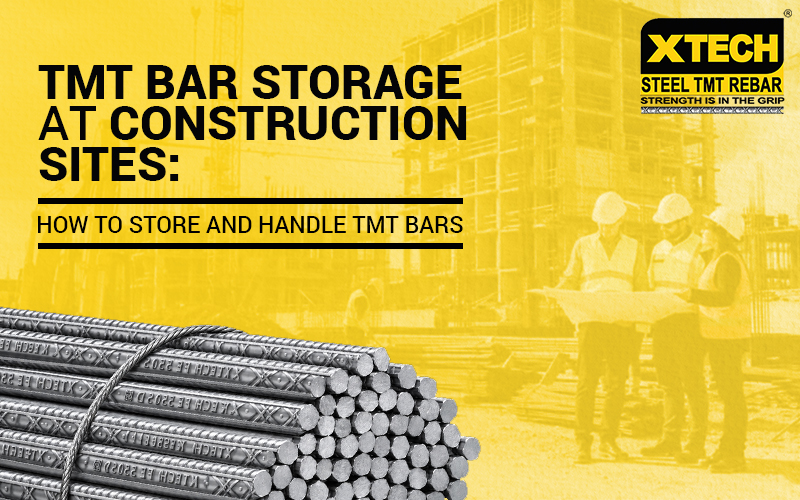
TMT Bar Storage at Construction Sites: How to Store and Handle TMT Bars
Choosing high-quality TMT bars is an important step in building a strong and durable structure. But protecting that quality does not end when the steel reaches the construction site.
Proper TMT bar storage and handling help protect reinforcement from moisture, contamination, corrosion and physical damage before it is embedded in concrete.
Even quality reinforcement steel needs proper site management.
Why Proper TMT Bar Storage Matters
TMT bars are designed to provide strength and reinforcement inside concrete. Before installation, however, they remain exposed to the surrounding environment.
Rain, humidity, standing water, mud, chemicals and careless handling can contribute to corrosion, contamination or physical damage.
Improper storage can also make it difficult to identify the correct grade or diameter, increasing the chances of mistakes during reinforcement work.
Good TMT bar storage practices help protect:
- Steel quality
- Bar dimensions and shape
- Surface condition
- Material identification
- Site efficiency
- Overall project quality
The Indian Standard IS 4082:1996 provides guidance on storing reinforcement to minimise distortion and corrosion and recommends keeping different classifications, sizes and lengths separately.
How to Store TMT Bars at a Construction Site
1. Store TMT Bars Above Ground
One of the most common mistakes at construction sites is placing reinforcement directly on soil.
Ground contact exposes TMT bars to:
- Moisture
- Mud
- Standing water
- Soil contaminants
- Increased corrosion risk
For longer storage periods, IS 4082:1996 recommends keeping reinforcement at least 150 mm above ground level.
Use suitable supports, sleepers or raised platforms so that water can drain away and air can circulate around the bars.
2. Protect TMT Bars from Rain and Standing Water
Northeast India experiences high rainfall and humidity, making moisture management particularly important at construction sites.
TMT bars should not be left submerged in water or stored in areas where rainwater regularly accumulates.
A covered storage area can provide additional protection. If tarpaulins are used, they should be arranged to protect the steel while allowing adequate ventilation rather than trapping moisture underneath.
The objective is simple: keep the TMT bars dry, clean and well ventilated.
3. Keep Different Grades and Diameters Separate
A construction project may require multiple diameters and grades of reinforcement.
For example, XTech TMT bars are available in Fe 500 and Fe 500D grades, with sizes ranging from 6 mm to 32 mm.
If different bars are randomly mixed at the site, workers may spend additional time identifying them or, more importantly, select the wrong bar for a particular application.
Store reinforcement according to:
- Grade
- Diameter
- Length
- Type or classification
Clearly marked storage sections can make material identification easier and help reduce errors during reinforcement work.
4. Handle TMT Bars Carefully
TMT bars are strong, but they should still be handled with care.
Dragging bars across rough surfaces, dropping bundles from a height or stacking them unevenly can cause unnecessary physical damage or distortion.
During unloading and shifting:
- Use appropriate lifting equipment where required.
- Avoid throwing or dropping bundles.
- Keep stacks stable.
- Use suitable supports.
- Prevent unnecessary dragging across the ground.
Good TMT bar handling protects both the material and the people working around it.
5. Keep TMT Bars Away from Chemicals and Contaminants
Construction sites contain cement, oils, chemicals, paints and other materials.
TMT bars should be stored away from substances that could contaminate their surface or affect their preparation before installation.
Mud, grease, oil and other contaminants should not be allowed to accumulate on reinforcement.
Before the bars are used, the site team should inspect them and follow project specifications and applicable standards for cleaning and preparation.
6. Inspect TMT Bars Before Use
A quick inspection before reinforcement work can help prevent avoidable problems.
Check for:
- Excessive corrosion or scaling
- Bending or distortion
- Mud or other contaminants
- Physical damage
- Correct grade and diameter
- Proper identification
It is also important to remember that not every trace of surface rust means a TMT bar is unusable. Light surface oxidation can occur when steel is exposed to air and moisture.
However, deeper corrosion, significant scaling or physical damage should be assessed before the reinforcement is used.
When there is doubt about the condition of reinforcement, the project engineer or qualified site professional should determine the appropriate course of action.
7. Avoid Unnecessary Long-Term Storage
The longer reinforcement remains exposed to weather, the greater the opportunity for moisture and contaminants to affect its surface.
Good material planning can help reduce unnecessary storage time.
Ideally:
Order → Receive → Store Properly → Inspect → Fabricate → Install
Keeping the construction schedule and reinforcement requirements coordinated can help minimise unnecessary handling and prolonged exposure.
How XTech TMT Supports Construction in Northeast India
XTech TMT bars are manufactured with a focus on strength, ductility, bonding and durability. Available in Fe 500 and Fe 500D grades and sizes from 6 mm to 32 mm, the bars are designed for a range of construction applications.
Manufactured using German Thermex quenching technology and featuring a precision-engineered X-Rib design, XTech TMT bars are developed with the demanding climatic conditions of Northeast India in mind.
The bars also feature an anti-corrosion microstructure designed to support durability in humid and flood-prone environments.
However, manufacturing quality is only one part of the equation.
Proper TMT bar storage, handling, fabrication and installation at the construction site are equally important parts of good construction practice.
From the factory to the construction site, every stage contributes to maintaining the intended condition of the reinforcement.
TMT Bar Storage: Quick Checklist
Before using reinforcement, make sure:
☑ Bars are stored above ground
☑ The storage area is clean and well
drained
☑ Rainwater does not collect around the
steel
☑ Different grades and diameters are
separated
☑ Bars are properly identified
☑ Bundles are stacked securely
☑ Steel is protected from unnecessary
contamination
☑ Bars are inspected before fabrication
and installation
Frequently Asked Questions About TMT Bar Storage
How should TMT bars be stored at a construction site?
TMT bars should be stored above ground on suitable supports in a clean, well-drained area. Different grades, diameters and lengths should be kept separately and clearly identified.
Can TMT bars be stored in the open?
TMT bars can be temporarily stored outdoors, but they should be protected from prolonged exposure to rain, standing water, mud and contaminants. For longer storage periods, a properly managed, covered and ventilated storage area is preferable.
Does surface rust affect TMT bars?
Light surface oxidation can occur when steel is exposed to air and moisture and does not automatically mean that a bar is unusable. Significant corrosion, scaling or physical damage should be assessed by the project engineer or another qualified professional.
How high above the ground should TMT bars be stored?
For longer storage periods, reinforcement should be kept sufficiently above ground to prevent contact with soil and water. IS 4082:1996 recommends keeping reinforcement at least 150 mm above ground level.
Why should different TMT bar sizes be stored separately?
Separating bars by grade, diameter and length makes identification easier and helps reduce the possibility of selecting the wrong reinforcement during fabrication or installation.
How can TMT bars be protected during the monsoon?
Store TMT bars above ground in a well-drained area, prevent standing water, protect them from direct exposure where practical and maintain adequate ventilation to avoid trapping moisture.
Quality Steel Deserves Quality Handling
Choosing the right TMT bar is only the first step towards good reinforcement practice.
Proper storage, careful handling, correct identification and timely installation all help maintain the condition of reinforcement before it becomes part of the structure.
From manufacturing to the construction site, every stage matters.
With XTech TMT, quality begins with engineered steel. At the site, proper storage and handling help preserve that quality until the bars become part of the structure.
XTech TMT - Engineered for Strength. Built for Trust.