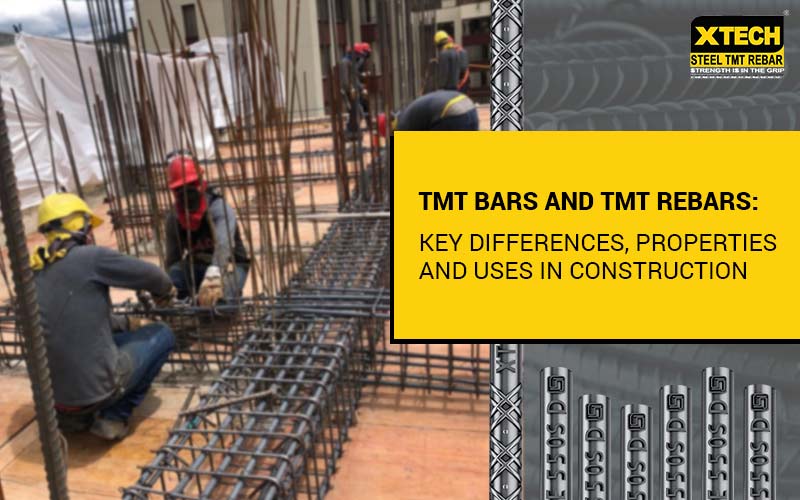
TMT Bars and TMT Rebars: Key Differences, Properties and Uses in Construction
In reinforced concrete construction, steel plays a crucial role in maintaining strength, flexibility and durability. Among the most commonly used reinforcement materials are TMT bars and TMT rebars. While both are essential for structural stability, they differ in design, performance and application. Understanding these differences helps builders and engineers choose the right material for long-lasting construction.
What Are TMT Bars?
TMT bars, or Thermo-Mechanically Treated bars, are steel reinforcement bars produced through a controlled heating and rapid cooling process. This process gives the bar a tough outer layer and a softer inner core. As a result, TMT bars offer high tensile strength, flexibility and resistance to stress, making them suitable for demanding structural applications.
These bars are known for their ability to withstand heavy loads, temperature variations, and seismic forces, which is why they are widely used in modern infrastructure and high-rise construction.
What Are TMT Rebars?
TMT rebars are reinforcement bars specifically designed to work in combination with concrete. Their ribbed surface improves grip and bonding with concrete, allowing both materials to act as a single unit under load. This strong bond reduces slippage and enhances the overall stability of the structure.
TMT rebars are commonly used in standard reinforced concrete work where uniform strength and consistent load distribution are required.
Key Differences Between TMT Bars and TMT Rebars
● Strength and Flexibility:
TMT bars offer higher tensile strength and better flexibility, allowing them to handle heavy loads and structural stress. TMT rebars are strong but are mainly designed for uniform reinforcement rather than high flexibility.
● Surface and Bonding:
TMT rebars have a ribbed surface that improves bonding with concrete and reduces slippage. TMT bars focus more on overall strength and load resistance.
● Corrosion Resistance:
TMT bars generally provide better resistance to corrosion and environmental exposure, making them suitable for demanding conditions. TMT rebars are commonly used in standard construction environments.
● Structural Use:
TMT bars are preferred for load-bearing and high-stress areas such as foundations, columns and beams. TMT rebars are used in slabs, walls and regular RCC work.
Where Are They Used ?
TMT bars are used in load-bearing parts of a structure such as foundations, columns and beams, where strength and flexibility are essential. They are also preferred in high-rise buildings and infrastructure projects, especially in areas that experience heavy loads or movement.
TMT rebars are used in regular reinforced concrete work, including slabs, floors, walls and partitions. They provide consistent reinforcement and strong bonding with concrete in residential and commercial construction.
Xtech TMT in Everyday Construction
Xtech TMT produces both TMT bars and TMT rebars to meet practical construction requirements across different project types:
● Xtech TMT bars are used in foundations, columns and load-bearing beams for enhanced strength and flexibility
● They are suitable for residential buildings, commercial complexes and infrastructure projects
● Xtech TMT rebars are commonly used in slabs, walls and routine RCC applications
● Manufactured under strict quality standards to ensure uniform strength and durability
● Designed to support safe, reliable and long-lasting construction
Conclusion
Both TMT bars and TMT rebars play vital roles in reinforced concrete construction. While TMT bars handle high loads and structural stress, TMT rebars ensure strong bonding and uniform reinforcement. Using the right combination of both helps create safer, stronger and more durable structures