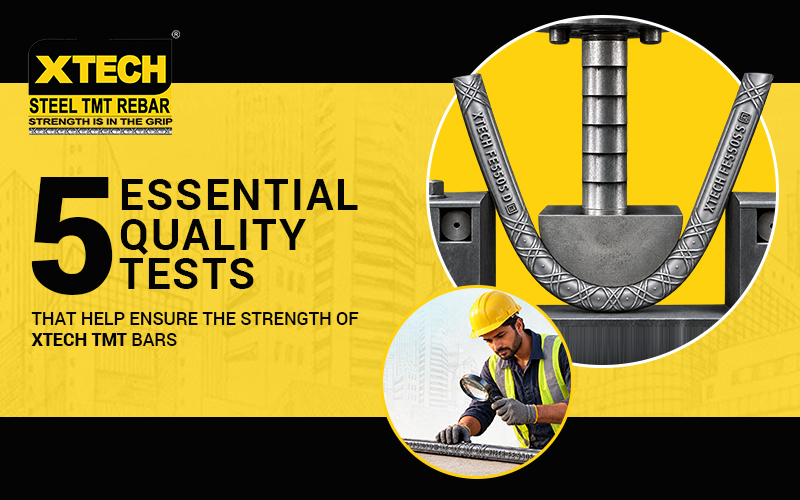
5 Essential Quality Tests That Help Ensure the Strength of XTech TMT Bars
The strength and durability of a building depend on several factors, and the quality of reinforcement steel is one of the most important. TMT bars form the structural framework of concrete buildings, helping them withstand different loads and stresses. However, not all steel bars offer the same level of performance. This is why quality testing plays an important role in determining whether TMT bars meet the required standards.
But what exactly goes into assessing the quality of TMT bars? Here are five important testing methods that help evaluate their strength, flexibility and overall suitability for construction.
1. Tensile Strength Test
The tensile strength test measures how much pulling force a TMT bar can withstand before breaking. It helps determine the steel's ability to handle tension, which is essential for reinforced concrete structures.
During this test, a steel sample is placed in a testing machine and gradually pulled until it reaches its breaking point. The test measures important properties such as:
● Yield strength: The stress at which the steel begins to deform permanently.
● Ultimate tensile strength: The maximum stress the steel can withstand before failure.
● Percentage elongation: The extent to which the bar stretches before breaking.
These measurements help assess whether the TMT bar meets the mechanical property requirements of its specified grade.
2. Bend Test
The bend test evaluates the flexibility and ductility of a TMT bar. During construction, reinforcement bars often need to be bent into different shapes to fit structural designs.
In this test, a steel sample is bent around a specified mandrel to a prescribed angle. The bar is then examined for visible cracks or fractures on its surface.
A satisfactory bend test indicates that the steel can undergo the required bending without showing signs of failure. This property is particularly important for reinforcement work involving beams, columns, slabs and other structural elements.
3. Re-Bend Test
While the bend test checks how a bar responds to bending, the re-bend test evaluates its behaviour after an additional treatment and bending cycle.
In this process, the steel sample is bent to a specified angle, subjected to the prescribed ageing treatment and then bent again in the opposite direction. It is subsequently examined for cracks or fractures.
The re-bend test helps assess the steel's ductility and its ability to withstand deformation under specified testing conditions. It is an important quality check for reinforcement bars used in demanding construction applications.
4. Chemical Composition Test
The chemical composition of steel plays a significant role in determining its strength, hardness, weldability and ductility. The presence and proportion of different elements can influence how the steel performs.
A chemical composition test analyses the percentage of elements such as:
● Carbon: Influences strength and hardness.
● Sulphur and phosphorus: Controlled because excessive amounts can negatively affect steel properties.
● Manganese: Contributes to strength and other mechanical properties.
The test helps verify whether the chemical composition falls within the permissible limits specified for the relevant grade under IS 1786.
Maintaining the required chemical composition is important for producing reinforcement steel with consistent and reliable properties.
5. Weight and Dimensional Test
The weight and dimensional test checks whether TMT bars conform to the specified diameter, length and mass requirements.
In this process, the dimensions and weight of the bars are measured and compared with the applicable standards. The test generally checks:
● Nominal diameter of the bar
● Length of the bar
● Mass per metre
● Permissible dimensional and mass variations
This test helps ensure that the reinforcement supplied is consistent with the specifications required for construction. It also helps builders and contractors estimate the quantity of steel needed for a project more accurately.
Why Quality Testing Matters When Choosing TMT Bars
Quality testing is not just a manufacturing requirement; it is an important part of ensuring that reinforcement steel meets the necessary performance standards.
For builders, contractors and homeowners, choosing properly tested TMT bars can help:
● Verify the specified strength and ductility of the steel.
● Ensure conformity with applicable quality standards.
● Support structural reliability when used in properly designed construction.
● Maintain consistency in reinforcement materials.
● Make informed purchasing decisions.
It is equally important to remember that the performance of a building depends on more than the quality of steel. Structural design, concrete quality, workmanship and proper construction practices all play essential roles.
Building with Confidence Starts with Quality
At XTech TMT, we believe that quality is fundamental to building structures that last. Our Fe 500 and Fe 500D TMT bars, available in sizes ranging from 6 mm to 32 mm, are manufactured using German Thermex quenching technology and are subject to quality checks.
By focusing on strength, ductility and consistency, we aim to provide reinforcement steel that meets the needs of modern construction.
When choosing TMT bars, always check the grade, relevant test results and applicable quality certifications before making a purchase.
XTech TMT — Engineered for Strength. Built for Trust.
For enquiries:
Phone: 91 70990 77676
Email: info@kdindia.com
Website: https://www.xtechtmt.com/


