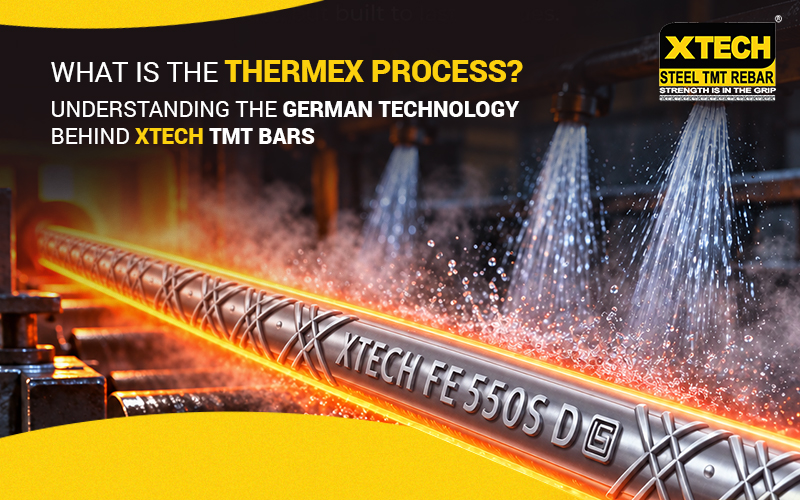
What Is the Thermex Process? Understanding the German Technology Behind XTech TMT Bars
The strength and durability of a structure depend significantly on the quality of materials used in its construction. Among these, TMT bars play an essential role in reinforcing concrete, providing the strength and flexibility required to withstand different structural stresses. But what gives TMT bars their distinctive combination of strength and ductility? Much of the answer lies in the technology used during their manufacturing.
At XTech TMT, we use German Thermex technology, an advanced thermo-mechanical treatment process that helps produce high-strength reinforcement steel. Through controlled water cooling and self-tempering, this technology develops a specialised internal structure that balances strength, toughness and ductility.
Let's understand how the Thermex process works, its different stages and why this technology matters in modern construction.
What Is German Thermex Technology?
Thermex is a specialised technology based on the Quenching and Self-Tempering (QST) process used in TMT bar manufacturing. It involves controlled water cooling followed by self-tempering, using the residual heat within the steel bar to develop its mechanical properties.
Unlike conventional cooling methods, the Thermex process rapidly cools the outer surface of a hot-rolled steel bar while allowing its core to retain heat. This creates a hardened outer layer and a comparatively ductile inner core.
This combination is important because reinforcement steel must withstand considerable stress while retaining the ability to deform without sudden failure.
How Does the Thermex Process Work?
The Thermex process involves three key stages that work together to develop the desired mechanical properties of TMT bars.
1. Quenching: Creating a Strong Outer Layer
After hot rolling, the steel bar passes through a specialised Thermex water-cooling system. High-pressure water rapidly cools its outer surface, forming a hard martensitic layer while the core remains hot.
This controlled cooling process establishes the foundation for the bar's strength and prepares it for the next stage.
2. Self-Tempering: Balancing Strength and Toughness
As the bar exits the cooling system, heat from its hotter core moves towards the cooler outer surface. This residual heat naturally tempers the hardened outer layer, transforming it into tempered martensite.
This stage helps improve the toughness of the outer layer, balancing hardness with the ability to withstand deformation.
3. Atmospheric Cooling: Developing a Ductile Core
The bar is then transferred to a cooling bed, where it cools naturally in the surrounding atmosphere. During this stage, the inner core develops a ferrite-pearlite structure, contributing to the bar's ductility.
The resulting TMT bar has a strong outer layer and a comparatively ductile core, providing the combination of mechanical properties required for reinforcement applications.
Key Benefits of Thermex Technology in TMT Bars
The Thermex process does more than simply cool steel. It helps develop the mechanical properties that make TMT bars suitable for modern construction.
1. High Strength
The controlled cooling process helps produce reinforcement bars with the yield and tensile strength required for different construction applications.
2. Improved Ductility
The comparatively ductile core allows the bar to undergo deformation before failure. This is particularly important when structures are exposed to dynamic forces and changing loads.
3. Better Toughness
The self-tempering stage improves the toughness of the hardened outer layer, helping balance strength with resistance to fracture.
4. Better Bendability
The combination of strength and ductility supports the bending and fabrication requirements of reinforcement work, provided the bars are handled according to applicable standards and specifications.
5. Consistent Mechanical Properties
Properly controlled manufacturing parameters help achieve the desired microstructure and mechanical properties throughout the TMT bar.
Why Are Strength and Ductility Important in Construction?
Concrete performs exceptionally well under compression but is comparatively weak under tension. TMT bars reinforce concrete by helping it withstand tensile forces and other structural stresses.
However, buildings and infrastructure may also experience vibrations, wind pressure, ground movement and seismic forces. Under such conditions, ductility becomes particularly important. It allows reinforcement steel to deform and absorb energy before failure, contributing to the overall performance of a structure.
This balance of strength and ductility is an important consideration when selecting TMT bars, particularly for construction in geographically diverse and seismically active regions such as Northeast India.
It is equally important to remember that structural safety depends on several factors, including sound engineering design, concrete quality, appropriate material selection and proper construction practices.
The German Technology Behind XTech TMT Bars
At XTech TMT, we believe that dependable construction begins with quality materials and the right manufacturing technology.
Our TMT bars are manufactured using German Thermex technology and are available in Fe 500 and Fe 500D grades, in sizes ranging from 6 mm to 32 mm.
By incorporating this advanced thermo-mechanical treatment process, we focus on producing reinforcement steel with the strength, ductility and toughness required for modern construction.
Whether it is a residential building, a commercial complex or an infrastructure project, choosing reinforcement steel that meets the required grade and quality standards is an important step towards building with confidence.
XTech TMT — Engineered for Strength. Built for Trust.
Explore our products: https://www.xtechtmt.com/
Contact: 91 70990 77676
Email: info@kdindia.com